

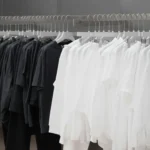
The material influences how a garment behaves.
It determines volume, movement, fit, comfort and the overall appearance of the silhouette. In circular knitwear manufacturing, understanding this relationship between fabric and construction is essential to developing a consistent product.
Each fabric structure, composition, weight and finish behaves differently. For this reason, material selection must reflect both the aesthetic and functional intentions of the garment.
What is circular knitwear?
Circular knitted fabric is produced through the continuous formation of loops on circular knitting machines.
This process creates a flexible and adaptable fabric structure, used across different garment categories, including T-shirts, sweatshirts, polo shirts, dresses, trousers and tops.
Its versatility depends on the combination of fibre composition, density, fabric weight and finishing. A lightweight, fluid fabric behaves differently from a compact, heavyweight structure or one containing elastic fibres.
Fabric structure and behaviour
Every knitted fabric has its own characteristics in terms of stretch, recovery, stability and drape.
A fluid structure promotes movement and lightness. A compact knitted fabric provides greater definition and allows for more structured volumes. The presence of elastane influences how the garment adapts to the body and recovers its shape.
Patterns, seams and finishes must be developed according to these properties.
The same construction technique will not produce identical results across different materials.
Fibre composition and fabric weight
Fibre composition influences the feel, appearance, durability and performance of a garment.
Cotton provides comfort and breathability. Cellulosic fibres can add fluidity and softness. Blends containing synthetic or elastic fibres allow strength and recovery to be adjusted.
Fabric weight also determines the structure and perceived quality of a garment.
Lighter fabrics are suitable for flowing garments and lightweight layers. Heavier fabrics offer greater structure and definition. The choice must balance aesthetics, functionality and the garment's intended use.
Fabric and pattern making
The pattern must respond to the actual behaviour of the knitted fabric.
Stretch, recovery and stability influence measurements, proportions and tension points. During sample development, fitting sessions allow the drape, volume and fit of the garment to be assessed.
Small pattern adjustments can improve the garment's shape and provide greater stability in specific areas.
This relationship between fabric and pattern is essential to ensuring consistency throughout production.
Cutting and construction
With flexible fabrics, cutting precision is essential.
Fabric positioning, grain direction and layer stability influence how the different components of a garment fit together. Automated cutting improves precision, repeatability and material efficiency.
During garment assembly, stitch type, tension and thread selection must accommodate the fabric's elasticity.
Necklines, armholes, shoulders, waistbands and hems may require reinforcement or specific finishing techniques to balance flexibility and stability.
Finishing and stability
Finishing processes affect the feel, surface, dimensions and behaviour of knitted fabrics.
Processes such as washing, softening and compacting must be considered from the development stage. Knitted fabrics may undergo dimensional changes after washing and wear, making it essential to validate their stability.
Testing makes it possible to anticipate shrinkage and adjust the pattern where necessary.
This level of control helps preserve fit, durability and the overall consumer experience.
Fabric and brand identity
Material selection is both a technical and an aesthetic decision.
The feel, texture, weight and movement of a fabric contribute to the visual language of a collection. Manufacturing must interpret this intention and translate it into an appropriate garment construction.
Developing a circular knitted garment requires coordination between fabric selection, pattern making, sampling, cutting, sewing, finishing and quality control.
SIDI develops and manufactures circular knitted garments for men, women and children, combining technical expertise, industrial capabilities and in-house production oversight.
Materials define possibilities. Construction turns them into products.